

Boston Whaler for sale

The Yachting Address view — Boston Whaler: the only production brand whose forty-year-old boats still sell for real money
In 1961, Life magazine published a photograph that became a legend of American boating: founder Dick Fisher sitting in a 13-foot Boston Whaler while a saw cut the hull in half — and the boat kept floating. Sixty-five years later, that demonstration still translates directly into euros on the used market: a re-powered 1980s Outrage still trades between 18,000 and 50,000 euros, while an equivalent-age standard fiberglass powerboat would be worth next to nothing. This is not recycled marketing — it is the direct consequence of a construction process the brand has never abandoned since 1958.
Dick Fisher, Ray Hunt, and the foam that cannot sink
Boston Whaler was founded in 1958 in Braintree, Massachusetts, by engineer Richard "Dick" Fisher. Fisher worked with naval architect C. Raymond Hunt — later credited with the deep-V hull that became the reference for the entire powerboat industry — to develop a fiberglass hull with rigid polyurethane foam injected between two glass skins. The result: a solid sandwich structure with no empty cavity, which cannot technically sink even if holed or sawn in two.
The yard then went through a turbulent ownership history — sold to the CML Group in 1969, acquired by Reebok in 1989, then by Meridian Sports in 1994 — before being bought by Brunswick Corporation in 1996. That last transaction matters: Brunswick also owns Mercury Marine and Sea Ray. Since 1996, every Boston Whaler has left the factory powered by Mercury, which explains the strength of the service network in Europe for recent models.
The naming trap: original tri-hull versus modern deep-V
This is the point many buyers miss when reading a Boston Whaler listing. Until the mid-1990s, the brand built so-called "cathedral" or tri-hull boats — a double inverted-V between two side sponsons, designed by Hunt for stability and shallow draft. After Brunswick's 1996 acquisition, production shifted to a more conventional deep-V hull, closer to industry standards for sea-handling and speed.
A 1988 "Outrage 22" and a similarly named model built after 2000 do not share the same hull architecture, the same sea behavior, or the same maintenance logic. On older models, always check the exact build year and hull type before comparing two listings that appear to carry the same name.
The model families: which series suits which buyer
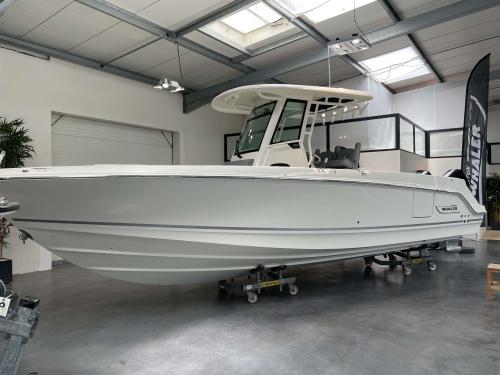
The Outrage range is the brand's historic core — center-console open boats built for offshore fishing, available today from the 170 (5.20 m) to the 380-420 (11.5-12.8 m). Center console with integrated head, wide side decks running to the bow, no concessions to accommodation: these are sea boats built to take a beating, not to sleep aboard. The Outrage 320 and 380 with triple or quadruple Mercury Verado power represent the brand's offshore flagship.
The Conquest range adds a cabin with berths and a head to the Outrage architecture. Powered exclusively by Mercury outboards (typically twin or triple Verado depending on size), it spans the 255 to 405. It is the most common family on the European used market, with 2005-2015 examples that have often seen heavy use and warrant a serious check of engine hours.
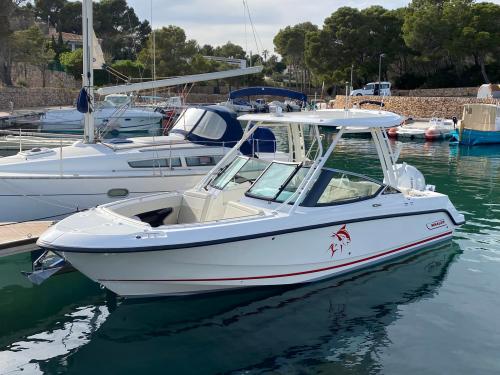
The Dauntless range is defined by its side console rather than center console, offering a more family-friendly layout for social use than for hardcore fishing. The Dauntless 270 in particular is sought after by Mediterranean buyers who want Whaler toughness for swimming and family day trips.
The Montauk range is the oldest and simplest in the lineup — a small center-console open boat between 4.5 and 6.5 meters, produced almost continuously since the brand's origins. An older, re-powered 17-foot Montauk, priced between 13,000 and 20,000 euros, remains one of the best entry points into the brand, or a superyacht tender that will never demand heavy upkeep.
What European buyers need to anticipate
Boston Whaler remains an American brand designed for North American waters and dealer networks. In Europe, this creates three practical realities to factor in before buying. First, the density of specialized after-sales support drops noticeably outside the major Mediterranean and Atlantic marinas — a mechanic genuinely familiar with the brand can be hard to find outside areas with a strong American-boat presence. Second, parts specific to the hull and factory equipment can have longer lead times than for a Bénéteau or Jeanneau, even though the Mercury powertrain itself benefits from a dense network across Europe. Finally, a meaningful share of older examples on the European market were directly imported from the United States — a point that calls for a systematic check of customs status and VAT before any commitment, particularly on boats built before the 2000s.
Points to check before buying used
Engine hours and Mercury service history — on outboard-powered models (recent Outrage, Conquest, Dauntless), a certified Mercury service history is the most reliable indicator of the boat's real condition. A poorly maintained twin or triple Verado setup represents a five-figure repair item.
Older sterndrive or OMC-outboard models — before the Mercury-only era, some 1970s-1990s Boston Whalers were powered by Volvo Penta sterndrives or OMC outboards. These powertrains are now harder to service in Europe due to a lack of parts and trained technicians — a recent Mercury repower is a genuine selling point on these boats.
Galvanic and electrolytic corrosion — the unsinkable hull poses no structural issue, but the fittings, wiring, and engine mounts of a boat used heavily in saltwater deserve a serious corrosion inspection, especially on examples that spent years in the Mediterranean without systematic fresh-water rinsing.
Import status — for any example that was clearly imported from the United States, request documentation confirming VAT payment and French registration compliance before any price negotiation.
Boston Whaler market prices in 2025-2026
| Model / Series | Generation | Market price |
|---|---|---|
| Montauk 15-17 (4.6-5.2 m) | 1975-2000 | €13,000 – 25,000 incl. VAT |
| Montauk 210 (6.5 m) | 2015-2023 | €100,000 – 130,000 incl. VAT |
| Outrage 18-22 (5.8-6.8 m) | 1978-1995 | €18,000 – 50,000 incl. VAT |
| Outrage 240-270 (7-8.3 m) | 2000-2010 | €45,000 – 110,000 incl. VAT |
| Outrage 320-380 (9.6-11.6 m) | 2004-2022 | €110,000 – 700,000 incl. VAT |
| Conquest 255-305 (8.2-9.8 m) | 2001-2010 | €70,000 – 120,000 incl. VAT |
| Conquest 345 (10.4-11 m) | 2008-2012 | €180,000 – 245,000 incl. VAT |
| Dauntless 160-270 (5-8.4 m) | 2007-2018 | €25,000 – 140,000 incl. VAT |
| Outrage 360 (11-11.6 m) | 2018-2023 | €590,000 – 800,000 incl. VAT |
Indicative price ranges, market as of May 2026. VAT included unless otherwise stated.
Our verdict
Boston Whaler is not the brand to choose for the best accommodation-per-euro, nor for the densest service network in the Mediterranean. It is the brand to choose for buyers who want a hull that will never structurally degrade regardless of decades of uneven maintenance — in exchange for a boat built firmly for the sea rather than cruising comfort. The exceptional value retention of old Whalers on the used market is no accident: it reflects genuine buyer confidence in a construction process that has never needed reinventing since 1958.