

Astondoa for sale





Astondoa second-hand yachts: the Spanish builder that Sunseeker and Princess buyers haven't discovered yet — and should
There is a quiet injustice in the luxury motorboat market: Astondoa, Spain's oldest pleasure boatbuilding yard, founded in 1916, has been building its boats for one hundred and ten years with a care and ambition that rivals the finest British and Italian houses — and still sells, on the second-hand market, at prices that structurally undervalue what these boats are actually worth.
This is not a recent discovery for industry professionals. Connoisseurs of the western Mediterranean — Catalan, Balearic, Ligurian harbours — recognise an Astondoa at first glance: its refined lines, its interior finishes matching the finest Italian yachts, and that solidity of construction that means 15-20 year old examples still navigate with the dignity of their early years. This guide aims to make this advantage visible for French and Northern European buyers who are still largely unfamiliar with the brand.
One hundred and ten years of history and an incomparable identity
Astondoa was founded in 1916 in Portugalete, in the Spanish Basque Country, on the banks of the Nervión estuary that also bathes Bilbao. The yard began by building traineras — those Basque fishing boats that became emblems of the Cantabrian maritime culture — before pivoting to lifeboats, then to pleasure craft in the 1960s-1970s as Spain discovered coastal tourism.
The transition to fibreglass, then to vacuum infusion and carbon construction, happened progressively but with a rigour that distinguishes Astondoa from yards that adopted these technologies purely for cost reasons. Today, the yard produces from Ares in Galicia boats from 11 to 60 metres in facilities among the most modern in Europe, including the largest five-axis machining centre dedicated to shipbuilding in Spain.
Over 3,000 vessels produced in one hundred and ten years — this is an industrial and technical legitimacy that very few Mediterranean yards can claim with the same consistency.
Decoding the Astondoa nomenclature
One of the difficulties for buyers discovering the brand is the nomenclature — Astondoa has used several designation systems through the decades, and second-hand listings often mix radically different generations under similar names.
The GLX nomenclature of older generations deserves explanation: GL designated "Gran Lujo" (Grand Luxury), the yard's top representation range, and X was added on extended versions. An Astondoa 72 GLX is therefore a grand luxury extended version at 21.84 metres — different from a simple "72" which could be a less-equipped base version. This distinction is central to understanding Spanish and Italian second-hand listings.
The current numeric nomenclature — 377, 52 Fly, 66 Fly, 677 Coupé — uses the first digits to indicate approximate size in feet. The 377 measures approximately 37 feet (11.61 m), the 677 Coupé approximately 67 feet (19.34 m). Simple once understood.
The AS range — AS5 (17 m), AS8 (25 m) — is the contemporary nomenclature for new-generation sport-cruisers, with a more aggressive design philosophy and lines that draw openly on the automotive world.
The Century range (100 Century, 110 Century, 120 Century) was created in 2016 to celebrate the yard's centenary — these are the brand's grand representation yachts in the 30-36 metre category.
The Steel range (120 Steel Explorer, 151' Steel, 185' Steel, 197' Steel) is the superyacht-in-steel range — explorer and long-voyage boats from 36 to 60 metres, playing in an entirely different category from the GRP models.
What genuinely distinguishes Astondoa from its competitors
Comparison with Sunseeker and Princess is natural as all three yards occupy comparable price segments and target similar clienteles. The difference lies in culture and construction rather than performance or habitability.
Sunseeker bets on aggressive lines, British performance culture and a popular imagination cultivated for thirty years through cinema and media. It is a brand of desire as much as a boat brand.
Princess bets on British craftsmanship, hand-finished woodwork and a durability that explains why 20-year-old Princess models still navigate with dignity.
Astondoa positions between the two: Princess's interior finish quality, with the more assertive contemporary lines of a Mediterranean builder that has integrated the aesthetic codes of Spanish automotive design. The current 677 Coupé, whose design "is inspired by the granular silhouettes of the automotive world" according to the yard's own communication, is the clearest expression of this identity: a boat that looks like what Aston Martin would build if the British brand ventured into yachts.
On the second-hand market, this identity produces a price anomaly that informed buyers exploit: an Astondoa 72 GLX from 2002 at €780,000 offers construction quality and habitability comparable to a Princess V72 of the same era — often sold €150,000 to €200,000 higher. The gap is purely brand awareness, not intrinsic boat quality.
The Astondoa second-hand market: reading the opportunities
The listings on this page offer a reading of the Astondoa second-hand market across its full price range — from €74,000 to €10 million. Here is how we read these opportunities.
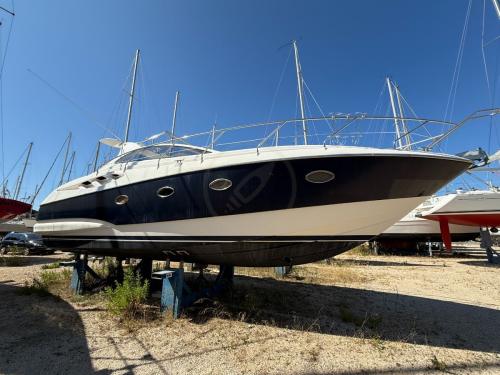
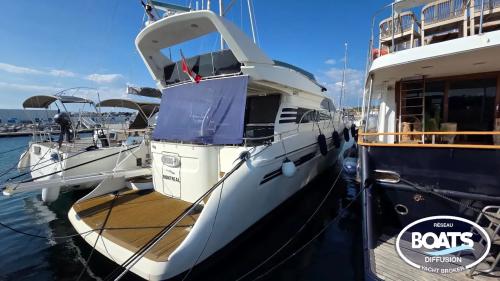
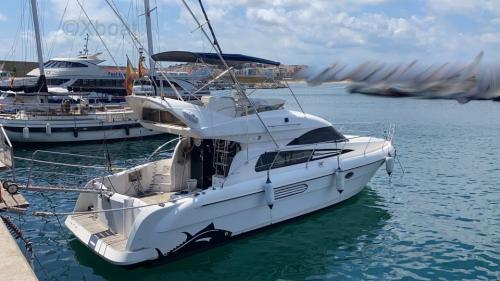
Small older Astondoas (35 Fly 1998, 39 Fly 2003, 40 Open 2005) between €74,000 and €199,000 represent brand entry points for accessible budgets. The 1998 Astondoa 35 Fly at €74,000 "convinces through its high-quality finish" according to its listing — this is precisely the strong point of these older Astondoas: at 25 years, the construction is still there. These are boats for enthusiasts who accept the maintenance of a Spanish yacht of this era.
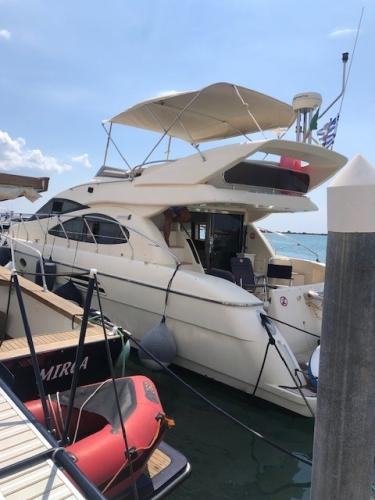
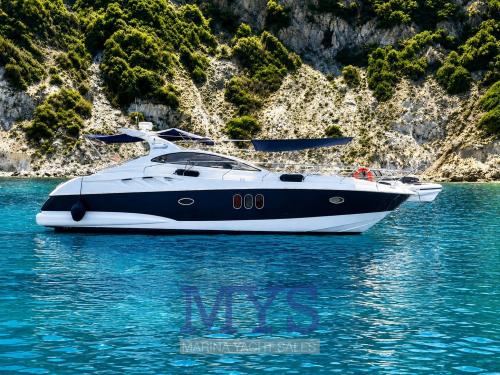
Astondoa 40 to 50-foot range (43 Open Hard Top 2006 at €199,000, 46 Fly 2000-2004 between €130,000 and €238,000, 464 AS 2007 at €249,000) is the most active centre of the market. These 12-15 metre boats are serious family yachts — twin Volvo Penta 500 hp on the 464 AS, generous flybridge and complete facilities. Their price is structurally low relative to their actual quality.
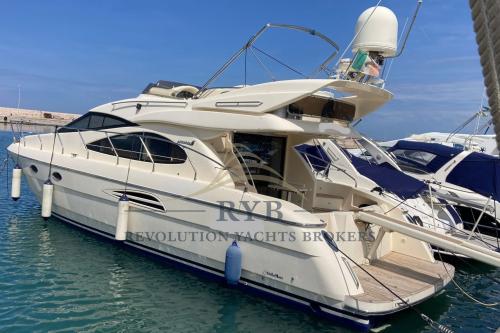
Astondoa 60 to 80-foot range (72 GLX 2002 at €780,000, 72 from 1999 at €483,000, 76 GLX 2007 price on request) are the most favourably imbalanced opportunities on the page: 21-23 metre yachts at prices that genuinely undervalue their intrinsic worth. The fully revised 2002 72 GLX at €780,000 deserves serious comparison with any equivalent 21-metre yacht on the current European market.
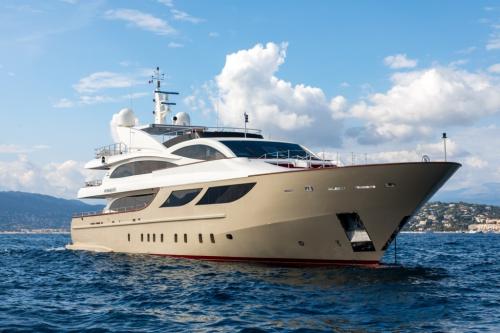
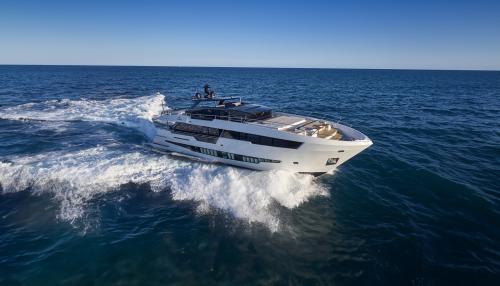
Large Astondoas (100 Century 2017 at €5.49 million ex-VAT, 150 Steel 2008 at €10.4 million incl. VAT) are in the superyacht category — a market with its own rules, its own experts, and its own buyers.
What to check when buying second-hand
Volvo Penta engines dominate the Astondoa second-hand range — V8 IPS on more recent models, D9 shaft drives on older ones. The same vigilance points as on Princess or Ferretti apply: complete service history with invoices, heat exchanger condition, MAN or Volvo service interval history depending on version.
Wood and leather interior finishes are Astondoa's primary value — and the first visible area of ageing. On older examples (1990s-2000s), mahogany or rosewood panelling deserves careful inspection: swelling, delamination, moisture traces. A full interior restoration on a 70-foot Astondoa represents €80,000 to €150,000 depending on scope.
Spanish documentation is a brand-specific point. Examples based in Spain or bought through Spanish brokers often have administrative documents (Lista Septima, Spanish registration) requiring local legal expertise for French buyers. Verify VAT status and flag before any serious negotiation.
Teak decking present on virtually all second-hand Astondoas deserves inspection — Spanish examples that have stayed afloat in Valencia or Alicante without regular maintenance often show degraded seams and lifted planks.
Astondoa market prices in 2025-2026
| Model | Year | Indicative price |
|---|---|---|
| Astondoa 35-40 (small older models) | 1998-2007 | €74,000 – €199,000 incl. VAT |
| Astondoa 46-464 AS | 2000-2007 | €130,000 – €249,000 incl. VAT |
| Astondoa 50-58 GLX (older generation) | 1991-2000 | €130,000 – €200,000 incl. VAT |
| Astondoa 72 GLX / 72 Fly | 1999-2007 | €450,000 – €800,000 incl. VAT |
| Astondoa 100 Century | 2017-2019 | €5,000,000 – €6,000,000 ex-VAT |
| Astondoa 150 Steel | 2008-2012 | €9,000,000 – €11,000,000 incl. VAT |
| Astondoa 377 Coupé (new) | 2024-2026 | Approx. €450,000 ex-VAT |
| Astondoa 677 Coupé (new) | 2025-2026 | €2,400,000 – €2,600,000 ex-VAT |
| Astondoa AS8 / AX8 (new) | 2024-2026 | €4,600,000 – €5,190,000 incl. VAT |
Indicative ranges, market May 2026. VAT included unless otherwise stated.
Our verdict
Astondoa is the choice of the buyer who wants the quality of a luxury European yacht without paying the brand awareness premium of the best-known British or Italian names. On the second-hand market, this structural undervaluation is a real opportunity — particularly on the 72 GLX and 100 Century models, whose quality-to-price ratios are among the most attractive in their respective price segments.
The condition for a sound purchase: surround yourself with an expert who knows the brand and can navigate the Spanish administrative documentation. Astondoa is not a difficult brand to own — it is a brand less well-known in France and Northern Europe than its merits justify. That is precisely why its best opportunities remain available a little longer than they should.