

Lagoon 47 for sale
Yachting Address Review — Lagoon 47: two catamarans, two generations, 34 years of history
The name "Lagoon 47" covers two boats that have almost nothing in common — except their naval architect, their builder, and a cruising philosophy that has endured more than three decades unchanged. The first Lagoon 47, launched in 1992, defined the offshore cruising catamaran for a generation of sailors. The new Lagoon 47, presented in world premiere at the Cannes Yachting Festival in September 2026, aims to do the same for the next. This guide allows you to read both markets intelligently.
The return of the "47" name: a deliberate decision
In the history of the Lagoon range, the number 47 carries particular significance. The first Lagoon 47, launched in 1992 and designed by Van Peteghem/Lauriot-Prevost (VPLP), was followed in 1998 by the Lagoon 470 — itself succeeded by the legendary Lagoon 450 (approximately 800 units built) and then by the Lagoon 46 (approximately 700 units over seven years).
By returning to the original "47" designation for its new 2026 model, Lagoon sends a deliberate message: this is not a simple incremental evolution of the 46. It is a project rethought from the ground up, reconnecting with the brand's origins and asserting the ambition to redefine what a 14-metre cruising catamaran can be. The naval architect remains VPLP — the same studio designing Lagoon boats since 1992 — further reinforcing this stated continuity.
The 1992 Lagoon 47: the founding catamaran
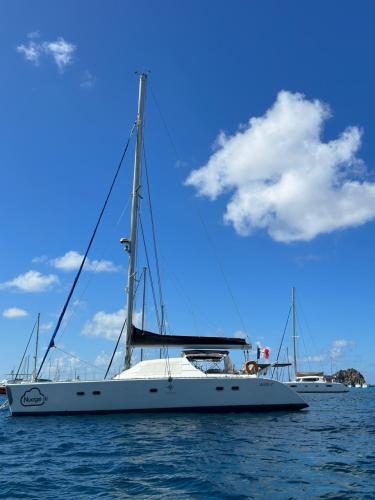
The original Lagoon 47 is a 14.10-metre overall length boat with a 7.60-metre beam. Its period powertrains (twin 38 hp engines) correspond to the offshore catamaran standards of the early 1990s — modest output by current standards, but sufficient for harbour manoeuvring and motoring passages on extended ocean voyages.
Its sail plan also reflects its era: a 66 m² mainsail and 27 m² genoa constitute a conservative sail plan, designed for seagoing safety and ease of short-handed handling. This catamaran was not designed for performance — it was designed for voyaging, durability and reliability on extended passages.
Thirty years after its launch, well-maintained examples testify to the robustness of this construction. The second-hand market for these boats typically sits between €250,000 and €350,000 depending on condition, equipment level and refits carried out. This is an accessible price for a bluewater catamaran of this size, attracting experienced sailors seeking a passage-making boat on a controlled budget.
The new Lagoon 47 (2026): official specifications
The official specifications of the new Lagoon 47 are available in the technical documents published by Lagoon in April 2026. These are the data — not those of the original model — that define the new boat.
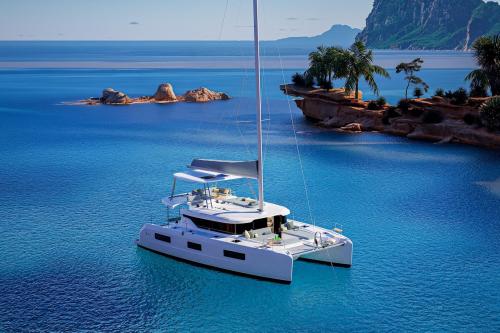
Hull length is 13.96 metres (45'10"), for an overall length with options of 14.95 metres. Beam is 7.96 metres — notably more generous than the 7.60 metres of the 1992 model. Draft is 1.25 metres, appropriate for Mediterranean and Caribbean anchorages. CE displacement reaches 18 tonnes — double the original model, reflecting the increased habitability and onboard equipment.
Propulsion is twin Yanmar 4JH57 57 hp SailDrive — 50% greater unit power than the original model, appropriate for the higher displacement. Fuel capacity is 860 litres in two 430-litre tanks, and maximum fresh water capacity reaches 700 litres.
The sail plan offers three mainsail options: standard furling (58 m²) for a total upwind area of 102 m², full-battened (80 m²) for 124 m², or square-top (84 m²) for 128 m². The optional Code 0 adds 86 m² of downwind canvas.
The design team is that of Lagoon's major projects: VPLP Design for naval architecture, Patrick le Quément for exterior design (the former Renault Design Vice President, creator of the Twingo and the Mégane), and Nauta Design for interiors.
The base price is announced at €680,000 ex-VAT — approximately €809,000 incl. VAT. This positioning reflects both the evolution of the premium catamaran market since 1992 and the increased ambitions of the new model.
What the forward door changes — the new 47's central innovation
The most significant architectural feature of the new Lagoon 47 is a forward door directly connecting the saloon to the forward cockpit — a first for Lagoon in this size category. Previously reserved for models over 60 feet, this configuration creates a continuous circulation between the aft cockpit, interior saloon and forward cockpit that transforms daily life aboard.
This innovation directly responds to feedback from 2,000 owners consulted by Lagoon before the launch — connection between interior and exterior spaces was the primary improvement expected. It is a simple, concrete architectural response whose impact on daily use is immediate.
Interior configurations: 3 cabins, 3+1 or 5 cabins
The new Lagoon 47 is available in three interior configurations corresponding to distinct uses.
The 3-cabin version is the owner's configuration — generous forward owner's cabin with front access (2.00 × 1.60 m bed), two guest cabins (2.00 × 1.50 m beds), two heads. This is the version maximising comfort for an owner cruising with family or close friends.
The 3-cabin +1 version uses the port mid-cabin — the "Smartroom" in Lagoon terminology — as a modular space convertible to cabin, dressing room or utility room as needed. This is the range's most flexible version.
The 5-cabin version is the charter configuration — capacity for 10 to 13 berths, 278-litre black water tank. This is the version for charter operators and investors who want to generate revenue through bareboat chartering.
What the two generations reveal about market evolution
The coexistence on this page of a 1992 Lagoon 47 and a pre-order for the new 2026 Lagoon 47 is a striking illustration of the evolution of the cruising catamaran market over 34 years.
In 1992, a 14-metre cruising catamaran weighed 9 tonnes, carried 93 m² of sail and was propelled by 2 × 38 hp. In 2026, the same name, the same size, the same naval architect — but 18 tonnes, 102 to 128 m² of sail plan depending on configuration, 2 × 57 hp, 860 litres of fuel, 700 litres of water, a forward door, a modular Smartroom and a design signed by a world-renowned automotive designer. The boat has doubled in displacement and sophistication for a price approximately 2.5 to 3 times higher in real terms.
This comparison is not a criticism — it is a description of a market that has profoundly changed its expectations, typical use (progressively fewer solo bluewater sailors, progressively more family semi-charter cruising) and clientele.
Lagoon 47 market prices in 2025-2026
| Generation | Year / Situation | Indicative price |
|---|---|---|
| Lagoon 47 — first generation | 1992-1997, good condition | €250,000 – €350,000 incl. VAT |
| Lagoon 47 — new generation (pre-order / new) | 2026-2027 | From €680,000 ex-VAT (~€809,000 incl. VAT) |
Indicative ranges, market May 2026. The new Lagoon 47 world premiere is planned at the Cannes Yachting Festival, 8-13 September 2026.
Our verdict
The "Lagoon 47" page has two faces — two boats, two markets, two entirely different life projects. The 1992 original Lagoon 47 is an opportunity for experienced offshore sailors who want a robust, proven and accessible catamaran for extended passages. The new 2026 Lagoon 47 is the most anticipated cruising catamaran of the year, whose Cannes world premiere in September 2026 will determine whether its architectural promises (forward door, Smartroom, le Quément design) are confirmed in real sailing conditions. These are two legitimate bets — provided you know which one you are making.