

Pardo 38 for sale
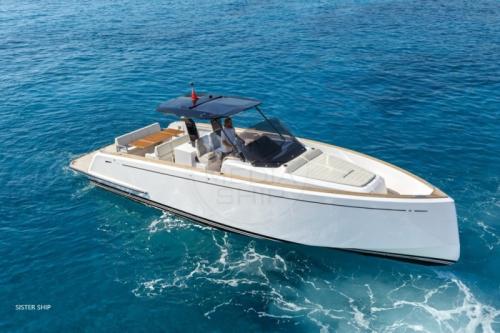
Yachting Address Review — Pardo 38: the Italian sport-cruiser that plays in the category above
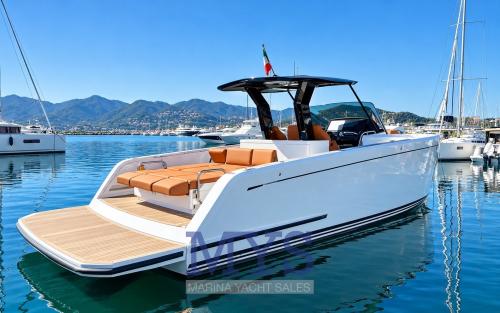
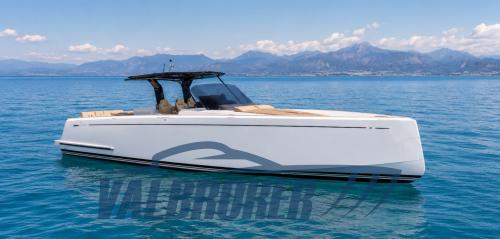
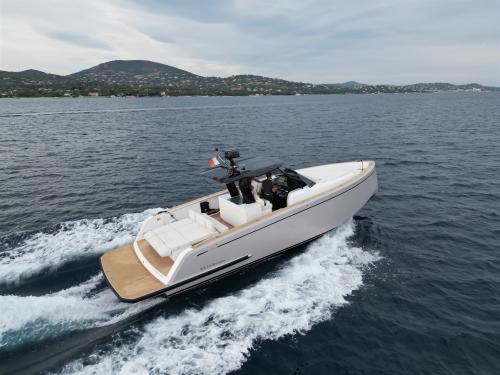
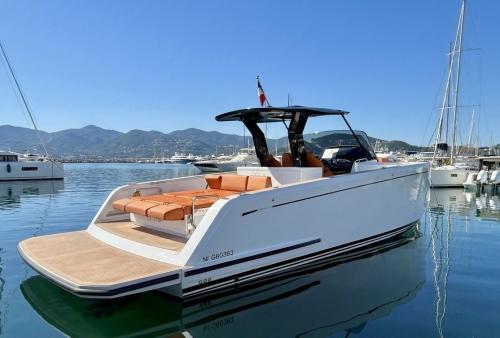
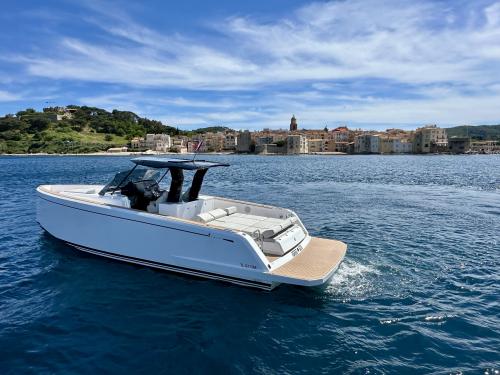
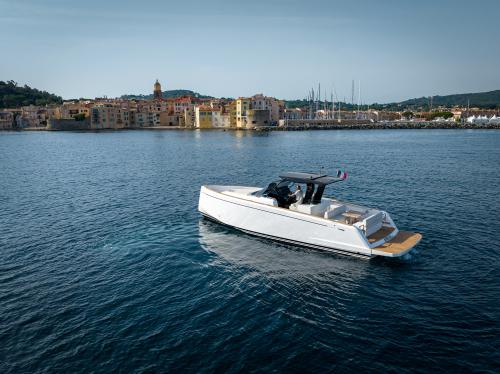
The Pardo 38 is the boat you notice entering a Mediterranean port before reading its name on the hull. Its lines are too taut, its deck too clear, its silhouette too refined for an ordinary production boat. It is not an ordinary boat. It is the proposal from Cantiere del Pardo — the Ferrara-based yard that also builds Grand Soleil sailing yachts — to answer one question: what if you built a motorboat the way you build a racing yacht?
The result is a sport-cruiser of 10.97 to 11.90 metres depending on the measurement convention, powered by Volvo IPS or outboards depending on the version, produced in very limited numbers since 2018. Its second-hand market on this page runs from €380,000 ex-VAT for a 2020 example to €590,000 ex-VAT for a 2023 — and prices hold because the limited production, unique visual identity and construction quality justify it.
Cantiere del Pardo: what the yard brings that others don't
To understand the Pardo 38, you need to understand who makes it — information rarely mentioned in listings.
Cantiere del Pardo is a boatyard founded in 1973 in Forlì, Emilia-Romagna, by Gianni Pardo. The yard is best known as the builder of Grand Soleil sailing yachts — a range of cruising and racing yachts that ranks among the most respected in Europe. Grand Soleil 46 or 52 owners know what Cantiere del Pardo means in construction terms: quality laminates, refined finishes, technical rigour from decades of performance sailing yacht production.
When Cantiere del Pardo launched its motorboat range Pardo Yachts around 2015-2016, it did not create yet another commercial brand. It applied to motorboat construction the same philosophy that had driven Grand Soleil's success: serious materials, rigorous construction, and design that makes no attempt to copy what already exists. The Pardo 38 is the direct product of this philosophy.
The Pardo 38 versions: what listings don't always distinguish
The listings on this page reveal three versions of the Pardo 38 that deserve clear distinction.
The standard Pardo 38 is the reference model — the Volvo IPS version with twin pods under the hull. This is the architecture that gives the boat its joystick manoeuvrability and its characteristic navigation behaviour. The 2020-2023 listings between €380,000 and €570,000 incl. VAT primarily concern this version.
The Pardo 38 Walkaround is a different deck architecture — passage around the boat is facilitated by a layout that opens the sides of the cockpit. This is the version for boaters who want freer aboard circulation, particularly for fishing or diving.
The Pardo 38 Outboard is the outboard version — one or two outboard engines replacing the IPS pods. This version is more recent and reflects the market's evolution toward outboards on premium boats of this size. Its stern profile differs slightly, and its maintenance is simpler than the IPS.
What the contradictory lengths in listings mean
Listings show lengths ranging from 10.95 to 11.90 metres for the same model — the same variable measurement convention we have documented on other brands.
The 10.95 to 10.97 metres designates the hull length alone. The 11.56 metres probably includes the aft swim platform. The 11.90 metres is the complete overall length including IPS pods or outboard engines. It is the same boat in all three cases — the usable deck length aboard is identical.
What the Pardo 38 offers that justifies its price
The Pardo 38 costs between €380,000 ex-VAT second-hand and €527,000 ex-VAT new in standard configuration. That is 30 to 50% more than a Jeanneau Leader 33 or a Prestige 420 of equivalent size. Here is what justifies that gap.
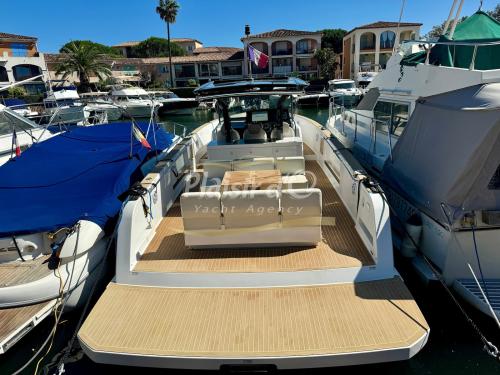
The exterior design is the first justification. The Pardo 38 is designed by Alessandro Centazzo, an industrial designer whose references cross the automotive and luxury yacht worlds. Its silhouette is recognisable from a distance — sharp horizontal lines, an almost entirely flush deck, an open cockpit that gives the impression of a 15-metre yacht's deck in an 11-metre boat. It is a design that will not age — unlike the "trends" of some Italian competitors.
The construction quality is the second justification. The composite materials used by Cantiere del Pardo in the Pardo 38 are the same as in the Grand Soleil — epoxy infusion, laminate quality, rigour of interior finishes. The Pardo 38's interior reaches a level that its same-price competitors do not systematically achieve: natural materials (oak, leather, marble depending on options), refined assemblies, details that show each example was built by hand by craftspeople.
The scarcity is the third justification. Cantiere del Pardo does not produce hundreds of Pardo 38s per year. Each example is a commission — an owner who waited, personalised, chose their materials. This scarcity translates into resale value that holds better than mass-production boats.
Pardo 38 against its real competitors
The honest comparison is with Italian premium sport-cruisers of 10-12 metres in the same price bracket — not with French mass-production builders.
Against the Cranchi E26 Endurance or Cranchi Mediteranée 44, the Pardo 38 is more radical in aesthetics, purer in its open-space concept, and slightly less habitable if the priority is bunk count. The Cranchi is more family-versatile; the Pardo is more exclusive on the visual and sensory experience.
Against the Ferretti 380, the Pardo 38 is sportier and lighter — the Ferretti prioritises yacht habitability and comfort; the Pardo prioritises navigation pleasure and design.
Against the Pershing 44, the Pardo 38 shares the same philosophy of Italian performance and elegance, but in a more accessible and more intimate format. The Pershing plays in the higher category in terms of speed and assertive status; the Pardo plays in the category of "discreet connoisseurs".
What the second-hand market reveals
The Pardo 38 second-hand market is still young — the first 2019-2020 units are only now arriving on the secondary market after 5-6 years of ownership. Observed prices trace a remarkably flat depreciation curve: a 2020 at €456,000 incl. VAT (Marines de Cogolin) versus a 2020 at €380,000 ex-VAT (Bormes) — which is approximately €380,000 + VAT = €456,000. VAT is the only real gap between these two listings of the same model year.
The 2023 listing at €570,000 incl. VAT at Marines de Cogolin represents the near-new market: 3 years old, low hours, slight discount from the current new price of €527,000 ex-VAT. The 3-4 year depreciation on a Pardo 38 remains below 15% — a resale value that very few production boats can claim.
What to check when buying second-hand
Volvo IPS pods on standard versions — same vigilance as on the Jeanneau Leader 33 or Bavaria Virtess 420: documented Volvo services, IPS joint membranes, pivot bearings. On a 2020 Pardo 38 now 5-6 years old, the first serious pod service must be documented with certified Volvo invoices.
Premium interior finishes — leather, oak, marble depending on options — are materials that deserve careful inspection. Pardo's oak ages well if maintained; leather may show wear on intensively charter-used or family-used examples.
Personalisation is a Pardo-specific point: each example being semi-custom, configurations differ. A complete inventory of standard and added options before any viewing — a "full options" configuration can represent €60,000 to €120,000 of additional equipment over the base version.
Pardo 38 market prices in 2025-2026
| Version | Year | Indicative price |
|---|---|---|
| Pardo 38 Volvo IPS (second-hand) | 2020 | €380,000 – €460,000 incl. VAT |
| Pardo 38 Volvo IPS (well-equipped second-hand) | 2021-2022 | €480,000 – €510,000 incl. VAT |
| Pardo 38 Volvo IPS (near-new) | 2023-2024 | €550,000 – €610,000 incl. VAT |
| Pardo 38 (new standard 2025-2026) | 2026 | From €527,000 ex-VAT |
| Pardo 38 Walkaround / Outboard (new) | 2026 | Price on request |
Indicative ranges, market May 2026. VAT included unless otherwise stated.
Our verdict
The Pardo 38 is one of the most accomplished sport-cruisers on the Mediterranean market in its price category — not because it is the most powerful, the most habitable, or the most widely distributed, but because it has something money alone cannot buy: total coherence between what it promises visually and what it delivers in use. Its second-hand price is supported by genuine scarcity, documented construction quality and a visual identity that does not age. For the buyer seeking an 11-metre boat that will still be above the fray in ten years — it is one of the rare choices that deserves this level of ambition.