

Beneteau Antares 12 for sale

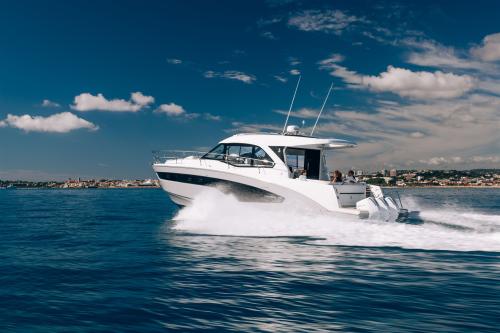

The Yachting Address Review — Bénéteau Antares 12
The Antares 12 may well be the Bénéteau model where confusion on the used market is both the most common — and the most dangerous.
When listings show one “Antares 12” at €110,000 and another at €583,000, the difference is not about condition or optional equipment. These are fundamentally different boats, built twenty years apart, with completely different architectures, engines and intended uses. Failing to understand that distinction before beginning your search is the easiest way to miss the boat you were actually looking for — or waste time visiting units far outside your real expectations.
Two generations, two completely different boats
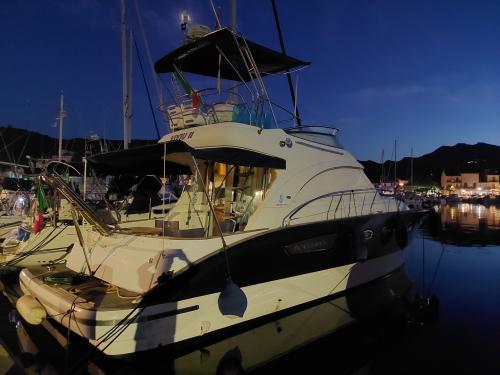
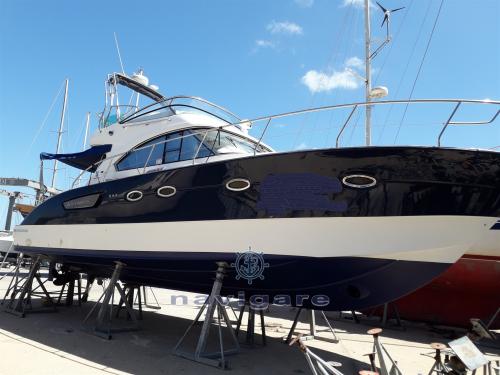
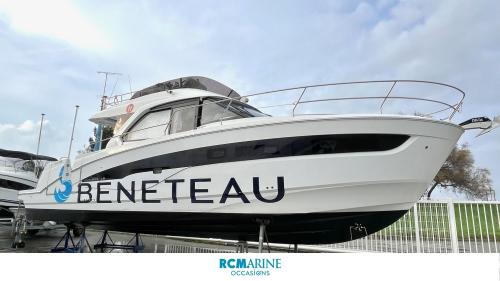
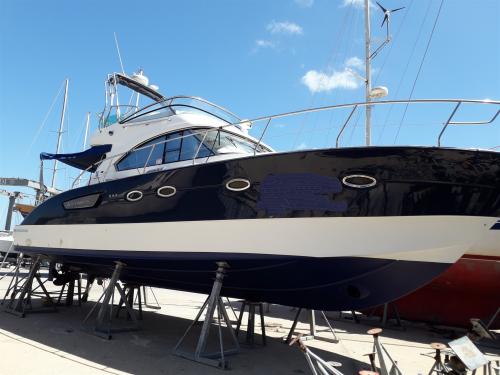
The first-generation Antares 12 (2004–2010) is a flybridge cabin cruiser powered by inboard diesel engines — mainly twin Volvo Penta D4 or D6 units — with an overall length between 11.96 and 12.62 meters depending on configuration. It represents the final expression of the classic inboard-powered Antares philosophy before Bénéteau shifted the range toward outboards.
These boats were built with the strong interior finish quality characteristic of the period, featuring generous accommodations — three cabins, two bathrooms, a central saloon and a proper flybridge — combined with reassuring sea behavior thanks to their low and stable hull designs.
On today’s used market, well-maintained 2005–2009 Antares 12 models generally trade between €105,000 and €165,000 depending on condition, engine hours and equipment. It is a niche market — these boats are relatively rare — but also a genuine opportunity for buyers wanting a 12-meter family cruiser with enclosed wheelhouse at a budget no longer possible with a recent Antares 11.
The key inspection points are typical of any aging diesel inboard cruiser: shaft lines and Cutless bearings, Volvo Penta service history, and the condition of the flybridge structure and sealing joints.
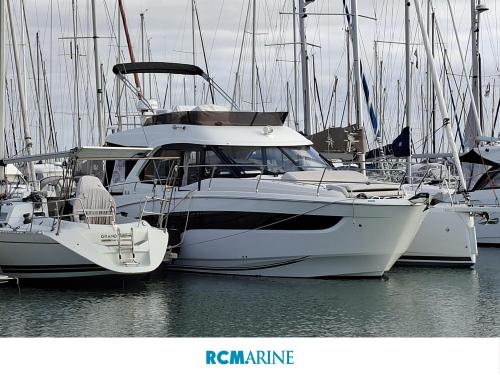
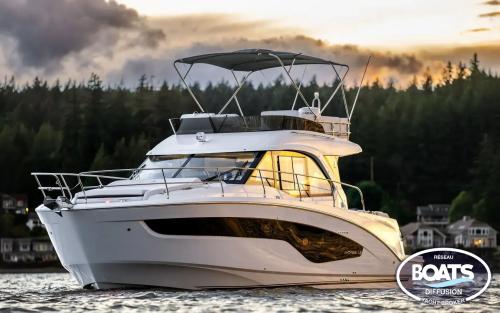
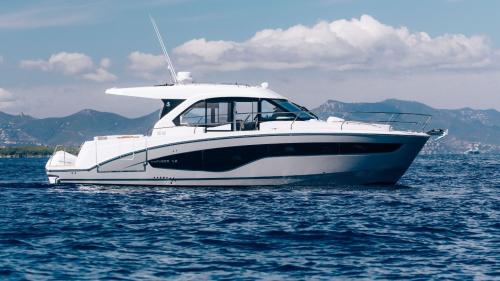
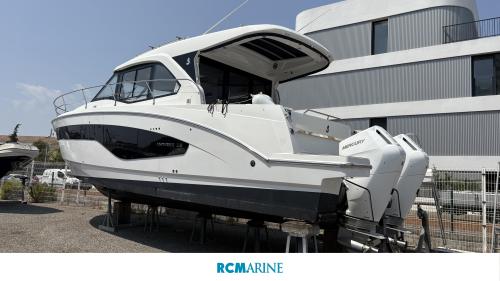
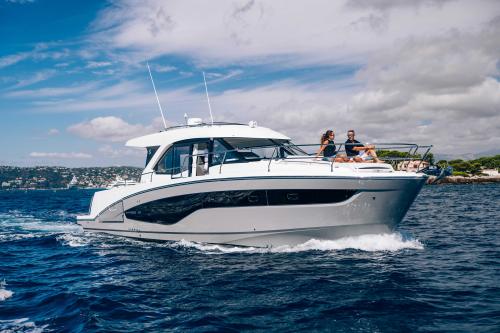
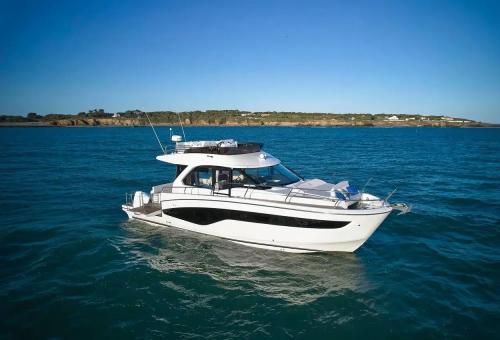
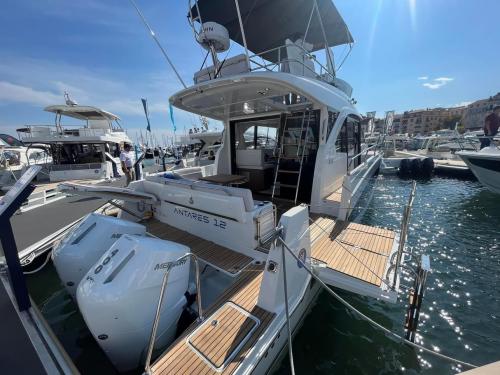
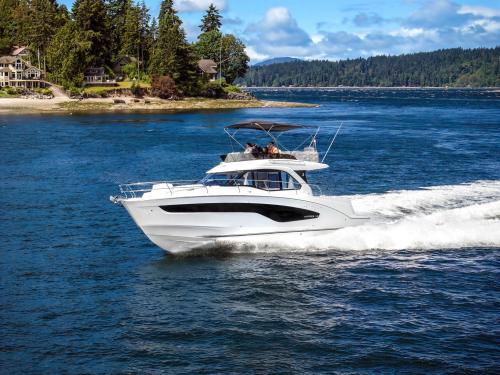
The new-generation Antares 12 (since 2024) represents a total break with that philosophy. It is the new flagship of the Antares lineup — designed from the beginning around outboard engines, with a latest-generation Air Step hull, a three-cabin layout and an integrated flybridge architecture. Power comes either from twin Mercury V10 Verado 400 hp engines or triple Mercury V8 300 hp engines for a combined 900 hp.
At 12.97 meters overall length, it symbolically crosses the 13-meter threshold and enters a different category in terms of marina access and mooring costs.
It remains essentially a new or nearly-new boat on today’s market. The few used examples available are mostly 2024 units with extremely low engine hours, typically priced very close to new-build levels (€430,000 to €500,000). Real depreciation on this model will likely only become visible after 2026–2027.
What the new Antares 12 genuinely brings
The qualitative leap compared with the Antares 11 is real and measurable — it is not simply an extra meter of length.
The first major difference is the three-cabin layout. The Antares 11 offers two enclosed cabins plus a convertible saloon. The Antares 12 offers three fully enclosed cabins with dedicated berths, including an owner’s forward suite with private bathroom and a full-beam aft cabin rivaling those found aboard compact motor yachts. For four adults or two families cruising together, the difference in onboard comfort is substantial.
The second structural advantage is the standard integrated flybridge. On the Antares 11, the Fly version remains an optional architecture with significant additional cost. On the Antares 12, the flybridge is integrated into the boat from the design stage — not simply added afterward. The result is greater structural and visual coherence, with an upper helm and lounge area benefiting from panoramic 360-degree visibility and a level of volume normally reserved for larger yachts.
The 1,174-liter fuel capacity fundamentally changes cruising autonomy. While a well-equipped Antares 11 typically carries between 450 and 600 liters depending on configuration, the Antares 12 carries more than double that amount — translating into a practical cruising range between 250 and 350 nautical miles at economical speeds.
For owners wanting to cruise from the French Riviera to Sardinia or spend several days in Corsica without technical stopovers, that represents a level of freedom the Antares 11 simply cannot match under equivalent conditions.
The optional Seakeeper gyroscopic stabilizer is the equipment that most dramatically improves life onboard at anchor and low speeds. On a boat of this size and price category, it becomes almost systematic on comfort-oriented configurations — and significantly increases resale appeal.
New Antares 12 engines: twin or triple?
This is the question every buyer asks, and it deserves an honest answer.
The twin Mercury V10 Verado 400 hp configuration is the most widespread and arguably the most coherent for standard family cruising. Eight hundred horsepower on a 13-meter boat delivers top speeds beyond 38 knots and comfortable cruising between 22 and 28 knots. Fuel consumption at economical cruising speeds (18–20 knots) generally remains around 90–110 liters per hour combined — reasonable for a boat of this size. It is also the configuration likely to retain the strongest resale value.
The triple Mercury V8 300 hp setup (900 hp total) is the high-performance version. It allows top speeds above 42 knots and offers exceptional propulsion redundancy offshore. The trade-off: higher yearly maintenance costs (three complete engine services), increased stern weight affecting trim slightly at rest and, in certain marinas, higher mooring fees calculated from larger engine categories. For conventional family cruising, the twin-engine setup remains sufficient in roughly 95% of real-world situations.
What to inspect on an older Antares 12
For the rare 2005–2009 Antares 12 models available today:
Volvo Penta D4 and D6 engines are reliable diesels, but at this age many are approaching or exceeding major service intervals. Request complete maintenance history with invoices and specifically verify injector condition, heat exchangers and circulation pumps. A healthy Volvo D6 can still provide another 1,500–2,000 hours; a neglected engine may require immediate overhaul.
Shaft lines and stern gear are the second critical inspection point. Stuffing-box sealing and Cutless bearing wear should ideally be checked during haul-out if haul-out history is unavailable.
Flybridge watertightness is the third major concern on older models. Plexiglass seals and deck joints age over time and may cause water ingress into the wheelhouse and forward cabins. Ceilings and woodwork should always be inspected for humidity traces.
Antares 12 market prices in 2025–2026
| Version | Model years | Indicative price |
|---|---|---|
| Antares 12 first generation (diesel inboard) | 2005–2009 | €105,000 – €165,000 |
| Antares 12 new generation (new 2024–2026) | — | €480,000 – €585,000 incl. VAT |
| Antares 12 new generation (nearly new) | 2024 | €430,000 – €500,000 |
Indicative ranges, May 2026 market. VAT included unless otherwise stated.
Who is the new Antares 12 really for?
The new Antares 12 targets a very specific owner profile — someone who previously cruised aboard an Antares 11 and wants to move upward without leaving the Bénéteau universe or the Antares philosophy.
It is designed for buyers wanting three real cabins, a structural flybridge, serious cruising autonomy and 400 hp-class outboards — without moving toward a traditional inboard motor yacht with significantly higher maintenance complexity and operating costs.
If your boating program involves intensive Mediterranean family cruising — Corsica, Sardinia, the Italian coast or Greece — with trips lasting 10 to 15 days in semi-autonomy, the new Antares 12 is one of the most coherent proposals currently available on the French market within its price category.
Our verdict
Two boats under the same name, two completely different markets. The older Antares 12 remains a genuine opportunity for buyers seeking 12 meters of family cruising at a contained budget. The new Antares 12 is the most accomplished expression of what Bénéteau currently knows how to build in large outboard-powered cruising boats beyond 12 meters — expensive, demanding, but remarkably coherent in its proposition. Its current rarity on the used market will likely only reinforce its appeal in the coming years.
- Antares 11
- Antares 12
- Antares 30
- Antares 6
- Antares 7
- Antares 8
- Antares 9
- Antares 9 OB
- Antares 10.80
- Flyer 10
- Flyer 6 Sundeck
- Flyer 6 SPACEdeck
- Flyer 7 SPACEdeck
- Flyer 7 SUNdeck
- Flyer 8 Spacedeck
- Flyer 8 SUNdeck
- Flyer 9 Spacedeck
- Flyer 9 SUNdeck
- Grand Trawler 62
- Gran Turismo 32
- Gran Turismo 36
- Gran Turismo 41
- Gran Turismo 45
- Swift Trawler 35
- Swift Trawler 41 Fly
- Swift Trawler 41 Sedan
- Swift Trawler 48