
 > Beneteau Antares 30
Beneteau Antares 30

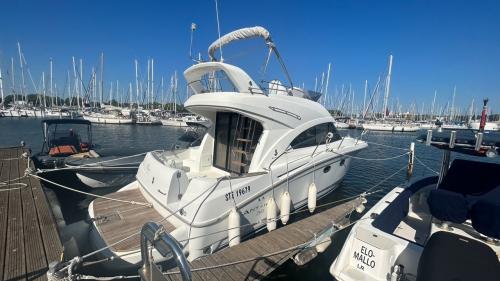

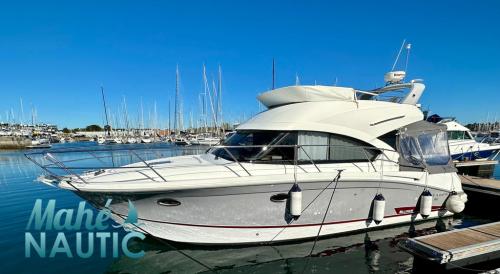
The Yachting Address Review — Bénéteau Antares 30 and Antares 36
The Antares 30 is one of the best-kept secrets of the French used motorboat market. Not because it is rare — quite the opposite, it remains widely present along both Atlantic and Mediterranean coastlines. But because its name, generation and engine configuration are consistently under-explained in listings.
Here is what buyers genuinely need to understand before searching for one.
Understanding the nomenclature: Antares 30, Antares 30 S, Antares 30 Fly, Antares 36
The previous-generation Antares range — the one preceding the shift toward outboard engines after 2018 — used an approximate feet-based naming structure. The Antares 30 is in reality a 9.98 to 10.22-meter boat depending on version, powered by diesel inboard engines. The “30” does not refer to metric length but to the historical Bénéteau model designation logic of that period.
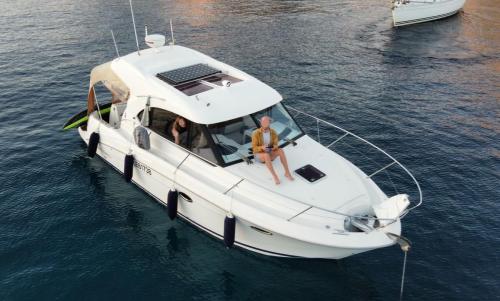
The Antares 30 S is the closed-wheelhouse version without flybridge — lower, visually sportier and with easier cockpit access. It is the rarest configuration on today’s used market but also the least expensive, generally between €85,000 and €130,000 for 2011–2016 models.
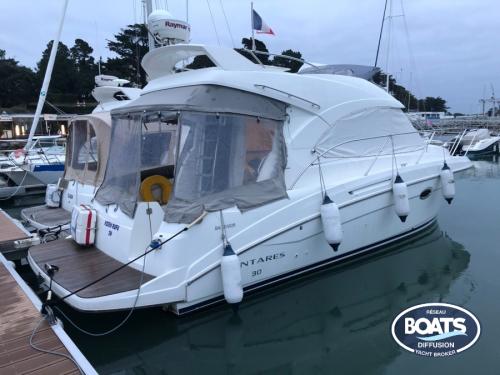
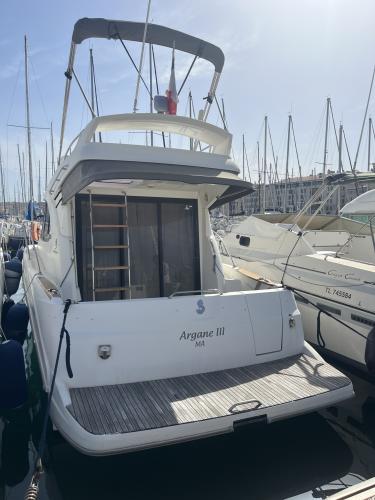
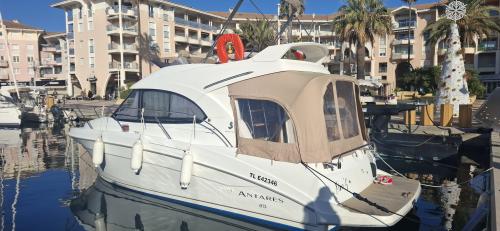
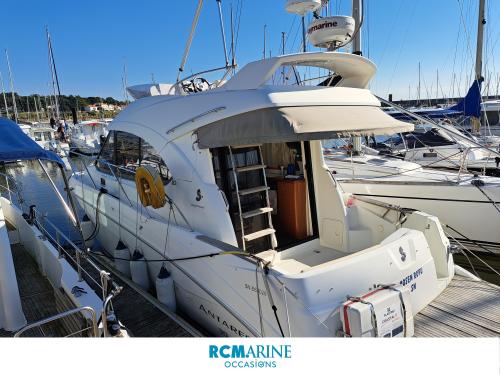
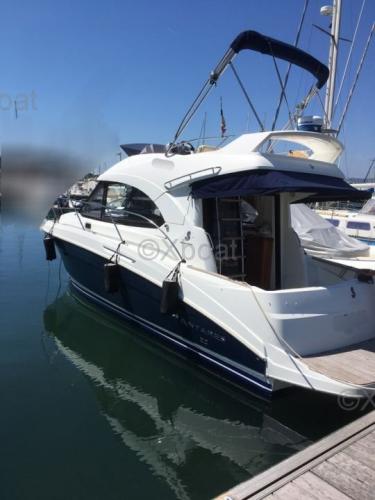
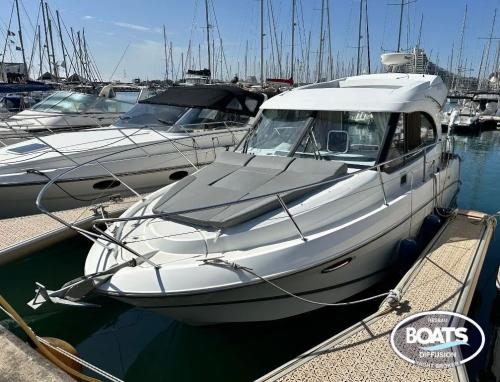
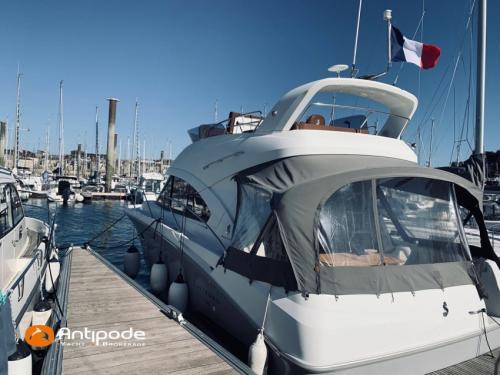
The Antares 30 Fly is the benchmark version — enclosed wheelhouse with a full flybridge above. This is the model dominating used listings, typically between €80,000 and €180,000 depending on model year and condition. The flybridge is unusually generous for a 10-meter boat, allowing owners to helm standing upright with panoramic visibility, dine outdoors comfortably and host additional passengers with ease.
The Antares 36 is an entirely separate model — 11.37 meters long, architecturally related but clearly positioned one category above, powered by twin Volvo D4 300 hp engines. It often appears grouped with the Antares 30 because of commercial proximity within the Bénéteau range, but it belongs to a completely different size and budget category (€145,000 to €200,000 on the used market).
What the Antares 30 Fly genuinely delivers
The Antares 30 Fly is arguably the most complete expression of what Bénéteau knew how to build in family inboard cruising boats during the early 2010s. Most units are powered by a single Volvo Penta D6 370 hp diesel — an unusual configuration on a 10-meter boat, delivering more than enough power while maintaining lower fuel consumption and simpler maintenance than twin-engine competitors.
Inside, the layout offers two enclosed cabins, a convertible saloon, a proper galley and a full bathroom.
What concretely separates it from period competitors such as the Jeanneau Leader 33 or Cranchi Endurance 30 is the quality of the wheelhouse. Bénéteau created a panoramic enclosed helm station with large glazed surfaces, near-360° visibility and genuine standing headroom throughout. In poor weather or during night passages, this becomes the real living space onboard — and on this very precise criterion, the Antares 30 Fly outperforms most of its contemporaries.
The flybridge adds a social dimension impossible to replicate on boats without an upper deck: elevated outdoor seating, secondary helm station and dining area accessible directly from the wheelhouse through an integrated staircase. During Mediterranean summer anchoring, it naturally becomes the center of life onboard.
The engines: the central issue on this model
The overwhelming majority of Antares 30 Fly models available today are powered by a single Volvo Penta D6 370 hp diesel. This is both the model’s greatest strength — and its main vulnerability on the used market.
The strength: one 370 hp diesel engine means simpler propulsion architecture, lower servicing complexity and access to Volvo Penta’s dense support network across French marinas. Parts availability remains excellent, qualified technicians are easy to find and yearly maintenance costs stay reasonable for a serious owner — generally between €1,500 and €2,500 annually.
The vulnerability: a single engine means zero propulsion redundancy offshore. In the event of mechanical failure, there is no second engine. For coastal cruising programs, many owners accept that compromise with proper preventive maintenance, a good toolkit and reliable VHF communication onboard. For owners navigating more exposed offshore areas, however, it remains a factor requiring serious consideration.
A few rare examples exist with twin Volvo D4 300 hp engines — particularly on late 2016–2019 configurations and systematically on the Antares 36. These versions offer redundancy and improved maneuverability but increase both servicing costs and fuel consumption.
What to inspect when buying used
The condition of the Volvo Penta D6 370 hp engine is the single most important inspection point. These engines are robust and well documented, but early examples are now approaching or exceeding fifteen years of age. Request complete maintenance records with invoices and specifically verify timing-belt replacement intervals, heat exchanger condition and overall engine wear through proper compression testing. A correctly maintained Volvo D6 can still provide another 1,500–2,000 hours of reliable operation; a neglected engine may require substantial rebuilding.
Shaft lines and stern gear are the second major inspection area. Stuffing-box sealing and Cutless bearing wear should ideally be checked during haul-out. Older units kept afloat year-round sometimes develop slow water ingress unnoticed by previous owners.
Flybridge watertightness is another classic issue. Plexiglass seals and deck joints age over time and may generate water infiltration into the wheelhouse. Always inspect ceilings, surrounding woodwork and flybridge covers carefully for humidity traces.
Cockpit and flybridge upholstery may also require attention on 2010–2013 boats never professionally refurbished. Full replacement typically costs between €2,000 and €4,000 and should be factored into negotiations if necessary.
Antares 30 market prices in 2025–2026
| Version | Model years | Indicative price |
|---|---|---|
| Antares 30 S (wheelhouse, no flybridge) | 2011–2016 | €85,000 – €130,000 |
| Antares 30 Fly (Volvo D6 370 hp) | 2011–2014 | €80,000 – €120,000 |
| Antares 30 Fly (Volvo D6 370 hp) | 2015–2019 | €120,000 – €180,000 |
| Antares 36 Fly (twin Volvo D4 300 hp) | 2010–2014 | €145,000 – €165,000 |
| Antares 36 Fly (twin Volvo D4 300 hp) | 2015–2019 | €155,000 – €200,000 |
Indicative ranges, May 2026 market. VAT included unless otherwise stated.
Who is the Antares 30 Fly really for?
This is the boat for owners wanting to enjoy several days at sea with family in genuine comfort, with an enclosed wheelhouse extending the boating season and a flybridge transforming every anchorage into a panoramic terrace.
It is not a fast boat — realistic cruising speed sits between 18 and 22 knots — and it is not designed for pure performance. It is a boat centered around life onboard: shared meals, coastal cruising, fishing returns under the evening sun and nights at anchor without compromise in comfort.
For that specific cruising program, between €100,000 and €160,000, it remains extremely difficult to find a more coherent proposition on today’s French used market.
The Antares 30 Fly possesses one of the rarest qualities in boating: it ages well, resells well and owners rarely speak about it without genuine affection.
Our verdict
A discreet, honest and remarkably solid classic of the French family cruising market. Not fashionable, not spectacular — but reliable, comfortable and more coherent in real-world use than many newer boats attempting to replace it. For families searching for their first true inboard cruising boat, it often remains one of the smartest entry points in this budget category.
- Antares 11
- Antares 12
- Antares 30
- Antares 6
- Antares 7
- Antares 8
- Antares 9
- Antares 9 OB
- Antares 10.80
- Flyer 10
- Flyer 6 Sundeck
- Flyer 6 SPACEdeck
- Flyer 7 SPACEdeck
- Flyer 7 SUNdeck
- Flyer 8 Spacedeck
- Flyer 8 SUNdeck
- Flyer 9 Spacedeck
- Flyer 9 SUNdeck
- Grand Trawler 62
- Gran Turismo 32
- Gran Turismo 36
- Gran Turismo 41
- Gran Turismo 45
- Swift Trawler 35
- Swift Trawler 41 Fly
- Swift Trawler 41 Sedan
- Swift Trawler 48